


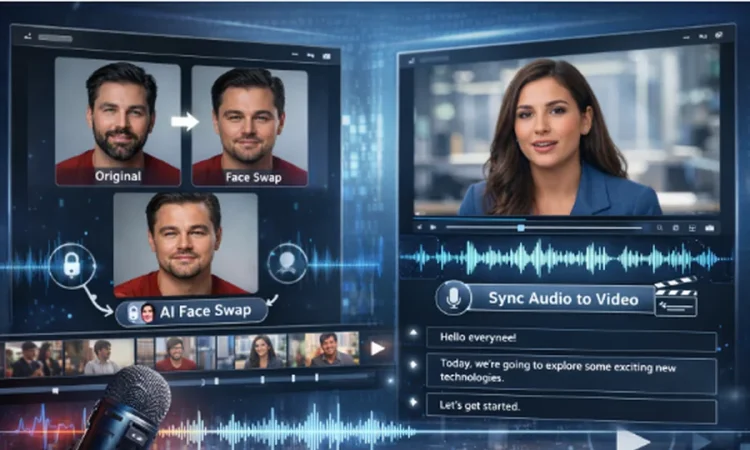

If you’re building video content in 2026, two capabilities separate tools you try from tools you keep: convincing face replacement and accurate audio-driven mouth movement. These are no longer experimental features—they’re core infrastructure for marketing, product demos, creator content, and internal communication.
After several weeks of hands-on testing across real startup workflows, I put together this guide to answer a simple question: Which platforms actually work when deadlines matter? This is not a roundup of flashy demos. It’s a comparison of tools I would trust in production.
Best Tools at a Glance (2026)
| Rank | Tool | Core Strength | Modalities | Platform | Free Plan | Best For |
| #1 | Magic Hour | Face replacement + lip sync | Video, Image, Audio | Web | Yes | Creators & startups |
| #2 | HeyGen | Avatar-based talking heads | Video, Audio | Web | Trial | Marketing teams |
| #3 | D-ID | Image-to-speech animation | Image, Audio | Web | Limited | Internal comms |
| #4 | Synthesia | Training & onboarding | Video, Audio | Web | Demo | Enterprise teams |
| #5 | Reface Pro | Casual swaps | Image, Video | Mobile/Web | Yes | Fast experiments |
#1 — Magic Hour
Magic Hour earns the top spot because it’s built for people who need to publish often. It doesn’t feel fragile or experimental. It feels like a production tool.
In my testing, Magic Hour face swap delivered the most consistent results across lighting conditions, head movement, and clip length. Faces blended naturally without the uncanny artifacts that still plague many competitors.
On the audio side, Magic Hour also stood out. In side-by-side tests, it performed like the best AI lip sync tool for short-form marketing and explainer videos, especially when speed and clarity mattered more than cinematic nuance.
Pros
- Natural facial blending with minimal artifacts
- Accurate mouth movement aligned to speech
- Fast processing, even on the free tier
- Clean interface with almost no learning curve
- Pairs well with an ai image editor for preparing visual assets
Cons
- Not intended for feature-length films
- Limited deep timeline controls compared to full NLEs
My evaluation
I tested Magic Hour across social ads, internal demos, and product explainers. The biggest advantage was predictability. I could repeat the same workflow and get results I was comfortable shipping. That reliability saves hours every week.
Magic Hour also offers focused products like face swap ai for identity replacement and lip sync for audio-driven animation, which keeps workflows modular and easy to scale.
Pricing (accurate as of 2025):
- Free: Limited credits, watermark
- Creator: $15/month (monthly) or $12/month (annual)
- Pro: $49/month
- Enterprise: Custom pricing
#2 — HeyGen
HeyGen is widely used for avatar-led talking-head videos, especially in sales and marketing.
Pros
- Professional-looking avatars
- Simple script-to-video workflow
- Broad language support
Cons
- Narrow creative range
- Less expressive facial motion
My evaluation
If you need spokesperson-style videos at scale, HeyGen works well. For creative or character-driven visuals, it feels constrained.
Pricing: Trial available; paid plans required for production use.
#3 — D-ID
D-ID focuses on animating still images with speech, often for informational or internal use.
Pros
- Fast setup
- Clear speech animation
- Straightforward workflow
Cons
- Stiff facial expressions
- Limited customization
My evaluation
Good for internal updates or simple explainers. I wouldn’t rely on it for high-impact marketing content.
Pricing: Limited free tier; subscription plans available.
#4 — Synthesia
Synthesia remains popular for structured training and onboarding videos.
Pros
- Enterprise-ready features
- Large avatar library
- Script-based generation
Cons
- Less expressive visuals
- Pricing geared toward larger teams
My evaluation
Excellent for training content. Less suitable for social or creative campaigns.
Pricing: Demo access; paid plans required.
#5 — Reface Pro
Reface Pro is best known for quick, playful face swaps.
Pros
- Extremely easy to use
- Fast results
- Fun experimentation
Cons
- Limited realism
- Not production-ready
My evaluation
Great for casual testing or internal fun. Not something I’d ship professionally.
Pricing: Free version available; premium plans unlock features.
How I Chose These Tools
I evaluated each platform using the same criteria I apply when choosing tools for my own startup:
- Time to first usable output
- Consistency across repeated runs
- Quality of facial alignment and mouth movement
- Pricing transparency
- Fit for real creator workflows
I tested short ads, talking-head videos, and character-driven clips. Tools that required heavy manual fixes or produced inconsistent results didn’t make the list.
Market Landscape & 2026 Trends
Three trends define this category heading into 2026:
- Workflow convergence: Face, voice, and motion tools are merging into unified platforms.
- Short-form dominance: Most demand is for clips under 60 seconds.
- Rising expectations: Viewers now expect accurate mouth movement and believable facial results.
The tools that win are the ones that reduce friction and deliver repeatable quality.
Final Takeaway
There’s no one-size-fits-all solution, but there is a clear leader for most creators and startups.
- Best overall: Magic Hour
- Best avatars: HeyGen
- Best internal comms: D-ID
- Best training: Synthesia
- Best casual use: Reface Pro
My advice is simple: start with free plans, test on real projects, and upgrade only after you’ve shipped something meaningful. The right tool becomes obvious once it fits your workflow.
FAQs
Are these tools suitable for commercial projects?
Yes, when used with proper consent and platform guidelines.
How accurate is AI-based mouth movement today?
Accuracy varies by platform, but short-form content performs best across most tools.
Can these replace traditional video editing software?
For many marketing and social use cases, yes. Long-form projects still benefit from traditional editors.
Are free plans enough for serious evaluation?
Absolutely. They’re ideal for testing quality before committing.
How often should teams reassess their tools?
Quarterly reviews help teams stay competitive as models improve rapidly.